Population-Weighted Geography Crosswalk
Overview
The weighting pipeline uses a population-weighted crosswalk to map PUMAs onto user-defined target zones. Because the source and target boundaries rarely align, Census blocks are rasterized into a population grid, PUMAs are rasterized into a label grid, and exactextract performs zonal cross-tabulation against the target polygons.
The implementation lives in src/processing/weighting/data_prep/crosswalk.py.
flowchart LR
    B["Census Blocks"] --> B1["Rasterize population"] --> B2["Population grid"]
    P["PUMAs"] --> P1["Rasterize IDs"] --> P2["Label grid"]
    Z["Target Zones\n(polygons)"]

    B2 --> X["exactextract\n(zonal stats)"]
    P2 --> X
    Z --> X

    X --> C["Crosswalk"]
Calculation Details
1. Rasterization
Two arrays are burned onto a common grid (CRS: EPSG:5070, NAD83 CONUS Albers) at a configurable cell size (default 250 m):
| Array | Dtype | Cell value |
|---|---|---|
Weight (pop) |
float32 | Block population distributed evenly across the cells each block covers: cell_pop = block_pop / n_cells |
| Source label | int32 | Integer ID of the source zone covering that cell (0 = no data) |
2. Zonal Cross-Tabulation (exactextract)
Both rasters are written to temporary GeoTIFFs and passed to exactextract together with the target-zone polygon layer:
exact_extract(
    [weight_path, source_path],
    target_gdf,
    ["values", "coverage"],
    include_cols=["target_id"],
)
For each target zone polygon z, exactextract returns per-cell arrays of:
v_i_weight: weight value of celliv_i_source: integer source-zone label of cellic_i: coverage fraction of celliby polygonz
In plain terms, each cell contributes weight value * polygon coverage fraction.
3. Population by Source × Target Zone
Within each target zone z, cells are grouped by source label s, and the coverage-weighted population is summed across all matching cells.
4. Allocation Weights
Each source zone's population is then normalized across target zones:
allocation_weight(s, z) = Pop(s, z) / total source population
By construction, the allocation weights sum to 1.0 across target zones for each source zone.
Worked Example
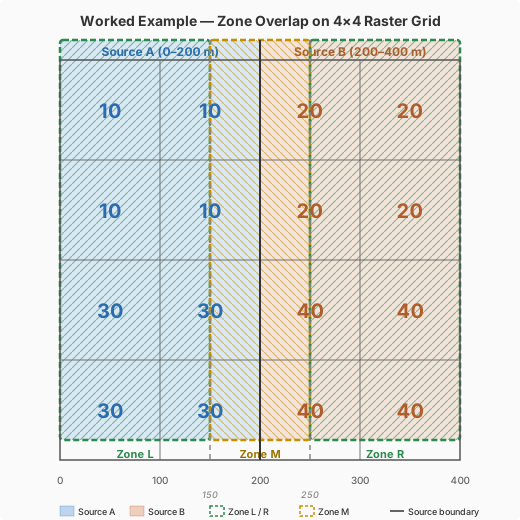
Assume a 4 x 4 grid of equal-sized cells, with each populated cell contributing 10 people.
- Source A occupies the left 8 cells, so its total population is
80. - Source B occupies the right 8 cells, so its total population is
80. - Zone L captures about
75%of Source A. - Zone M captures the remaining
25%of Source A and25%of Source B. - Zone R captures the remaining
75%of Source B.
That gives the following source-by-target populations:
| Source | Target zone | Population contribution |
|---|---|---|
| A | L | 60 |
| A | M | 20 |
| B | M | 20 |
| B | R | 60 |
Now normalize within each source zone:
For Source A:
allocation_weight(A, L) = 60 / 80 = 0.75allocation_weight(A, M) = 20 / 80 = 0.25
For Source B:
allocation_weight(B, M) = 20 / 80 = 0.25allocation_weight(B, R) = 60 / 80 = 0.75
So the final crosswalk rows would look like this:
| source_id | target_id | allocation_weight |
|---|---|---|
| A | L | 0.75 |
| A | M | 0.25 |
| B | M | 0.25 |
| B | R | 0.75 |
This is the key idea: each source geography is split across target zones in proportion to the coverage-weighted population captured in each target polygon.
Settings and code
The crosswalk is set by the geography block of Compute Weights.
The PUMA-specific wrapper is in processing.weighting.data_prep;
the generic build_crosswalk, which works for any source, target and weight polygons, is in
utils.